
A promotion! That’s awesome news! Look at you, flying high!
As your career unfolds, it’s easy to de-prioritise money management. It's daunting, overwhelming, or exhausting to make the necessary decisions at a time when you feel more time poor. But as you are earning more the decisions around your money become increasingly important.
So, let’s explore essential money management moves you want to think through as your career progresses.
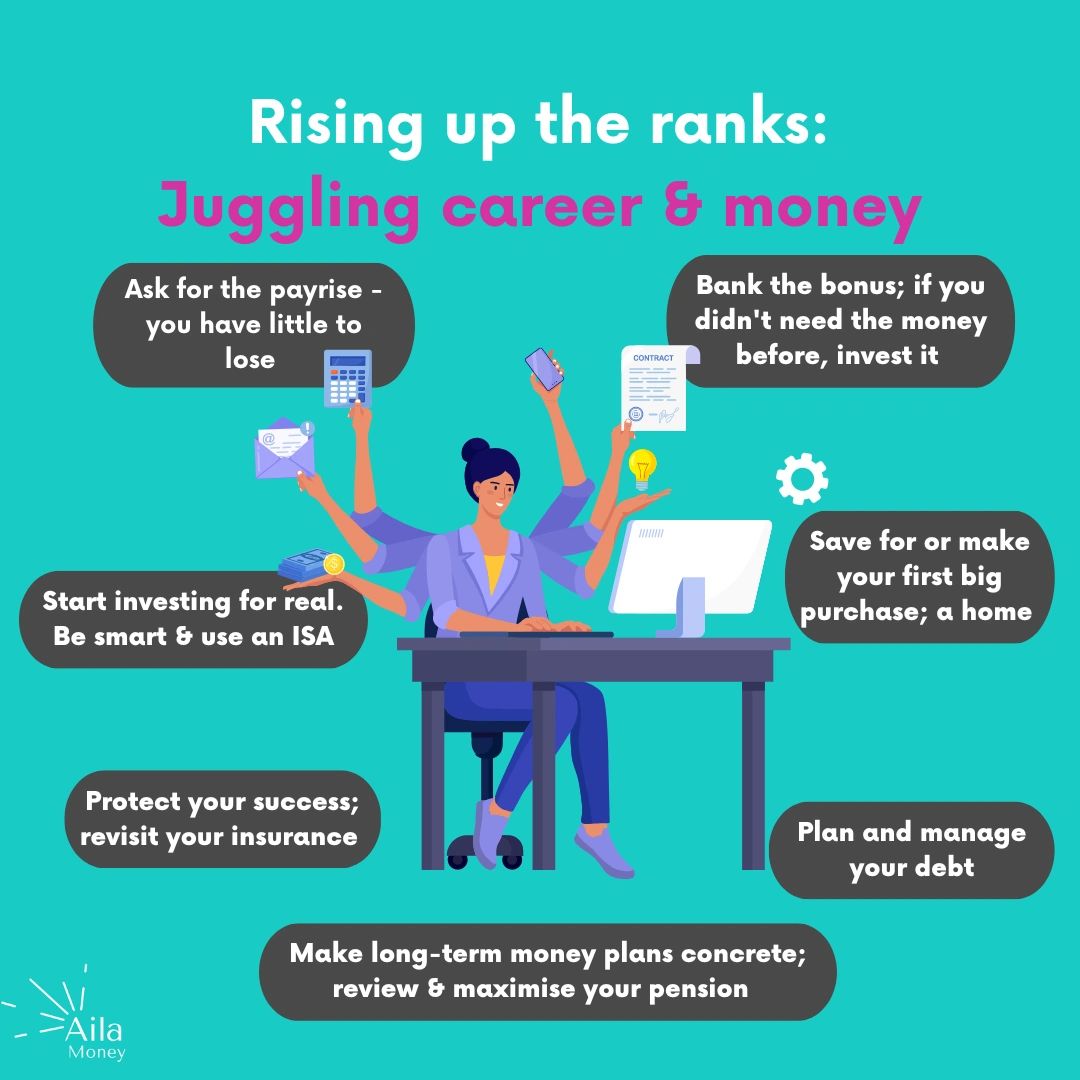
As your career progresses, it's natural to aspire to and receive higher compensation. While you can’t plan a perfect career, it’s important to use your success, your skills and the situations that you face at work to progress. What do we mean by that?
When seeking a pay rise or looking for a new job where you’ll negotiate salary, arm yourself with evidence of your successes and contributions. Be able to quantify and articulate your achievements.
Know what your skills and experience are worth. Some industries have transparent pay scales, and sights like glassdoor.com give you a good indication as well.
Finally, seize situations that are offered to you. Both in terms of demonstrating your ability to deliver, and as opportunities to ask for a pay rise or seek a new job.
As women, keep in mind that research has found we have an ‘unentitled mindset’, meaning we are less likely to demand and ask for things that we’ve earned. These emotions of “am I really worth it” or thoughts around “is the timing right? Is my case watertight?” are normal.
Three tips we’ve used:
- Be mindful of lingo: women use the word “we” and “just” more than men. This dilutes the impact of what is said. These might seem small, but when asking for a higher salary it is for you, not anyone else.
- Before asking for a pay rise, practice. And immediately before the conversation do a power pose (Amy Cuddy). It’ll increase your confidence!
- Loyalty is good. So is knowing your worth. To know your market value, apply for a job every couple of years. It’s great interview practice and you can sense-check your market value.
So, while it’s easily said and much harder to do, be confident in your worth, and present a well-prepared case during negotiations. Your value to the company deserves recognition and the worst outcome is a bruised ego and no change to the money situation.
A bonus is an amazing recognition for your work. And while we’re not here to tell you not to spend on yourself and splurge a bit, do consider how much your bonus can contribute to your longer-term life and financial goals. These might be, building an emergency fund, or other life goals like a house, or family.
On a separate note…when your total income from salary and bonus exceeds GBP100k, you need to complete a self-assessment tax form. It’s worth speaking to a tax advisor if you are nearing that or have exceeded that threshold. Aila Advisor can help.
As you start to make more money, consider investing. High-earning women who don’t invest, stand to lose out on more than £800k over their career (ellevest). So, while it might feel daunting to start investing, over time, investing outperforms what you can get from a savings account.
Tax-efficient Individual Savings Accounts (ISA) are a great way to get started. Stocks and shared ISAs offer tax advantages. You can invest up to £20k per year without paying tax. If you’re interested in taking the plunge, make sure you understand:
- your risk appetite,
- the different things you can invest in
- how to best diversify what you’re investing in
Investing is complex, and Aila can help.
As your wealth grows, the dream of a home becomes a reality. To help you get there, take advantage of a Lifetime ISA (LISA). A LISA is a tax-free investment account aimed at helping you reach your first home deposit faster. When you put money into a LISA the government contributes an extra 25% of what you have put in, up to £4000; so, when you invest £4000, you receive an extra £1000. For free! All gains from the LISA are also tax free. A LISA ensures you're one step closer to turning your dream home into a reality. (One to note is the LISA for your first home can only be used to buy a house up to £450,000)
With your LISA savings in place, it's time to secure your first home. Research mortgage options carefully to find terms and interest rates that work for you. Given the current interest rate environment, it’s wise to speak to a mortgage advisor to work through different options. Always be mindful that your monthly mortgage payments align with your budget and long-term financial goals. If you’re keen to speak to a mortgage advisor, Aila Advisor can help.
As financial responsibilities grow, make sure you are consciously planning and managing debt. Many of us have been taught that debt is a bad thing, and we should pay it off above everything else. This is largely true for high interest rate debt items, such as credit cards. But there are times where this isn't the case, these include 0% introductory rates and reward schemes. Though these are good to use and help build up your credit, it is important to ensure you can pay these off before the high interest rates kick in - setting up a direct debit and keeping track of the amount due each month is helpful.
Other debt – like mortgage payments – are equally important and should be planned and managed into your budgeting cycle. What’s encouraging, is that every time you repay some of your mortgage your share of ownership in the house increases!
With that being said, in the current high interest rate environment, it’s worth considering whether repaying the principle will bring you more peace of mind, relative to investing that money… It’s worth seeking financial advice on this one if you’re unsure and Aila Advisor can help.
Protection is an often-overlooked aspect of money management that grows in importance as your career progresses. Life, Critical Illness and salary insurance offer safeguards for you and your loved ones.
Life insurance ensures your family is financially secure in the event of an unexpected tragedy, providing them with the money to cover expenses. Critical illness insurance provides a lump sum to you if you are diagnosed with a critical illness. It is worth highlighting both insurances are cheaper to buy when you are younger - and before any health issues are found.
Salary insurance acts as a safety net in case of disability or illness that may prevent you from working. Having these protective measures in place, means you've taken proactive steps to secure your future.
Though retirement still feels far away, the earlier you start contributing the better because of compounding. Contribute consistently to your workplace pension scheme, taking advantage of employer matching. Also know that you have an annual contribution allowance, currently £60k, which you can use as you start earning more. Depending on your financial situation, there is a couple of things you may want to consider:
1. If you haven't used your total allowance in previous years you are able to back fill for the past 3 years.
2. The allowance of £60k is tapered above £260k going down to £10k per year if you earn more than £360k.
If your pension options are something you’d like to explore, Aila Advisor can help.
As your career takes off, so will your finances. To achieve your life, career and financial goals, build a solid money management foundation. Empower yourself to make informed decisions, and despite the hassle, prioritise money management. You’re managing ever-more responsibility at work, so we have every confidence you’ll cope with this too!
Try Aila now to get personalised tips on how to manage your money in line with your life and career goals.
Follow Aila's social media for more money tips:
Download Aila and start building better money habits with personalised guidance, action tracking, and expert support.
Download Aila Free